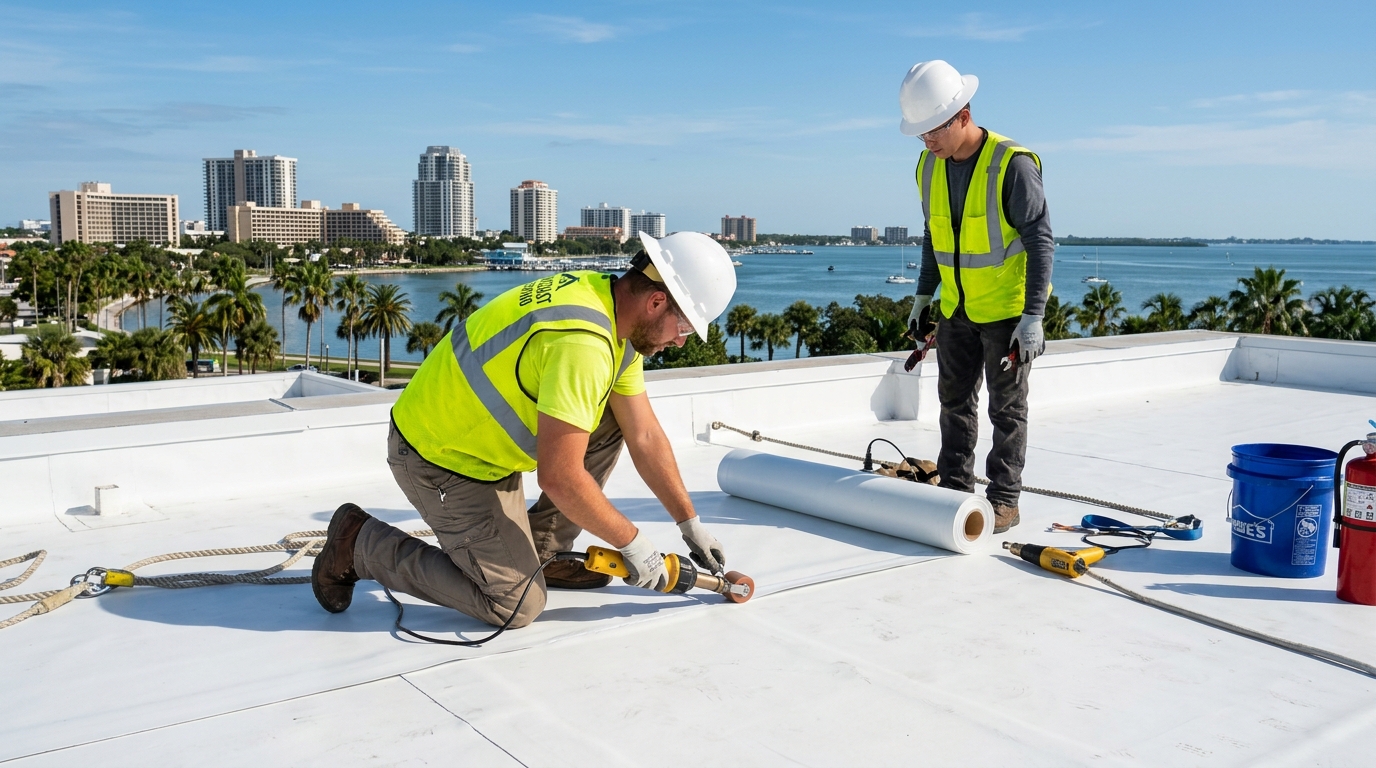
Flat Roof Ponding & Membrane Leak Repair in Seattle, WA
Low-slope and flat roofing systems on Seattle commercial buildings, multi-family residences, and modern homes face immense hydraulic pressure during the Pacific Northwest rainy season. Falling tree debris frequently blocks roof scuppers and internal drains, creating massive ponding lakes that exploit aging membrane seams. Roof Expert USA dispatches commercial roofing specialists experienced in TPO, PVC, and modified bitumen systems to eliminate ponding, weld seam breaches, and restore positive drainage.
Protocol 2: Emergency Drain & Scupper Clearing to relieve thousands of pounds of trapped hydrostatic head.
Protocol 3: Infrared Roof Moisture Surveys to identify wet polyiso insulation boards before wood rot spreads.
Protocol 4: Independent Washington L&I Commercial Roofing Contractors experienced in Puget Sound drainage.
1. Regional Microclimate Dynamics & Severe Storm Exposure in Seattle
Flat and low-slope roofing in Western Washington requires specialized engineering because rainfall cannot drain via gravity as swiftly as on steep-slope roofs. Seattle's abundant tree canopy drops large volumes of leaves and Douglas fir needles onto flat roofs. When these decay, they form dense muck that clogs internal drainage bowls, scuppers, and downspout conductors. Water accumulates into ponding areas holding thousands of pounds of hydrostatic weight. If ponding persists for more than 48 hours, standing water accelerates chemical breakdown of asphaltic membranes and exerts hydrostatic pressure that penetrates microscopic seam voids.
Forensic inspection of flat roofs requires advanced moisture detection methods. Dispatched technicians perform non-destructive electronic capacitance scanning and infrared thermography after sunset to locate trapped moisture within underlying polyisocyanurate (polyiso) insulation boards. Seam probing with specialized blunt tools tests lap joints along TPO and PVC sheets, while parapet walls and coping metal are inspected for thermal movement and sealant failure.
Containment and repair protocols depend on the specific membrane substrate. For TPO and PVC systems, technicians thoroughly clean the aged membrane using specialized solvent primers and heat-weld new reinforced membrane patches using commercial hot-air welders (operating at 800°F–1,000°F) to create molecularly fused seams. For modified bitumen roofs, technicians apply cold-applied elastomeric mastic reinforced with polyester fabric scrim. Severely depressed ponding areas are built up using tapered insulation saddles or auxiliary scuppers are cut through parapet walls to re-establish positive drainage per local code.
4. Washington State Department of Labor & Industries (L&I) & Code Compliance
All commercial and residential low-slope repairs adhere to the Seattle Building Code (Chapter 15) and National Roofing Contractors Association (NRCA) low-slope specifications. Contractors maintain active Washington L&I commercial endorsements, substantial liability coverage, and manufacturer certifications for major membrane brands (Carlisle, Firestone, GAF, Johns Manville).
Property managers and building owners should inspect flat roof drains and scuppers monthly during the autumn and winter months. Ensure metal debris strainers are installed over all drain bowls to prevent leaves from clogging internal leader pipes. Immediately address any ponding water that remains on the roof surface longer than 48 hours after rain ceases.
When an active roofing failure or skylight leak threatens your property during prolonged Puget Sound rainfall, following standardized safety procedures prevents personal injury and minimizes secondary structural damage while dispatched crews are en route:
Strict Fall Hazard Prevention: Never attempt to access a roof during rain, windstorms, or freezing cold snaps. Wet moss-covered shingles across King County become as slick as ice, creating severe slip-and-fall hazards. Dispatched professional crews operate under strict Washington DOSH fall protection standards with full-body harnesses and roof anchors.
Electrical Circuit Shutdown: Immediately switch off electrical circuit breakers governing any living areas where water is dripping from ceilings, skylight wells, light fixtures, or wall outlets to avert electrical shorts and structure fires.
Controlled Interior Drainage: Relieve trapped water weight behind bulging ceiling drywall by puncturing the center of the blister with a small nail or screwdriver and catching the flow in large buckets, preventing catastrophic ceiling collapse.
Independent Referral Model Assurance: All dispatched contractors are independent, licensed, and registered third-party roofing professionals under Washington L&I regulations. Estimates, insurance scopes, and physical repairs are contracted directly with the assigned roofing contractor.
What causes ponding water on a flat roof in Seattle?
Ponding is primarily caused by insufficient slope (less than 1/4 inch per foot), sagging roof rafters, or drains and scuppers clogged by decaying leaves and fir needles. Water standing for more than 48 hours violates building code and accelerates membrane decay.
Can an emergency patch be applied to a wet flat roof?
Yes. Dispatched crews use commercial-grade wet-surface elastomer mastics and reinforced mesh membranes engineered to bond underwater, temporarily arresting leaks until the roof dries and permanent heat-welding can be performed.
How do technicians locate leaks on flat roofs when the membrane appears intact?
Technicians perform nighttime infrared thermal scans. Because wet insulation retains heat longer than dry insulation, the camera reveals glowing thermal rectangles indicating exact moisture saturation underneath the surface.
Need Immediate Emergency Assistance for Flat Roof Ponding & Parapet Repair?
Our Seattle dispatch desk routes qualified, Washington L&I registered contractors 24/7. Strictly zero web forms—speak directly with a live dispatch coordinator right now.